Paper

OUT NOW our preprint titled “The Grainyhead/LSF transcription factor GRH-1 is rhythmically required for molting”

The molting cycle in C. elegans is tightly coupled to the rhythmic accumulation of thousands of transcripts. Here, using ChIP-seq and quantitative reporter assays, we
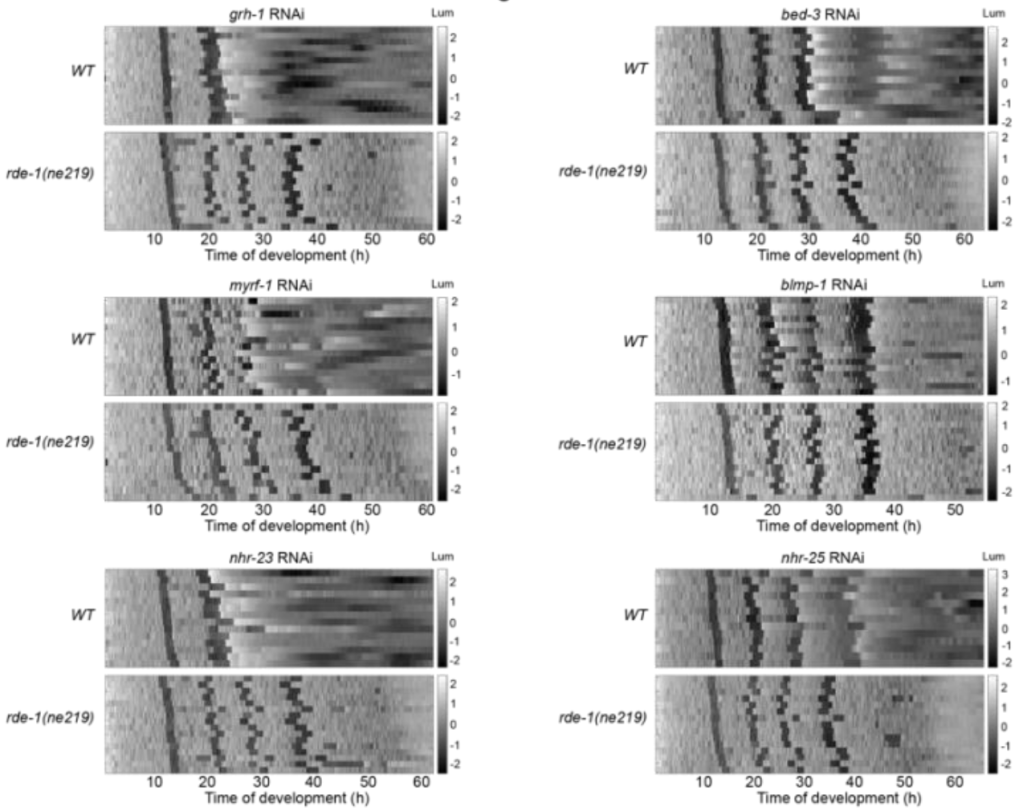
show that these dynamic gene expression patterns rely on rhythmic transcription. To gain insight into the relevant gene regulatory networks (GRNs), we performed an RNAi-based screen for transcription factors required for molting to identify potential components of a molting clock. We find that depletion of GRH1, BLMP-1, NHR-23, NHR-25, MYRF-1 or BED-3 impairs progression through the molting cycle.
Read our preprint at bioRxiv and a thread with the key findings @LabGrosshans


Paper

OUT NOW our preprint titled “The BLMP-1 transcription factor promotes oscillatory gene expression to achieve timely molting”

In C. elegans, a genetic oscillator directs rhythmic accumulation of ∼25% of the transcriptome. The mechanism and organization of the oscillator are not known. In this work we identified BLMP-1 as a rhythmically accumulating transcription factor that is required for timely molting, and oscillatory gene expression.
Read now our preprint at bioRxiv and a thread with the key findings @LabGrosshans.

People

Welcome to our new postdoc, Abhi, and farewell to Chiara!

Abhi obtained a bachelor’s degree in Biotechnology Engineering. Later at the Indian Institute of Science (IISc), Bangalore, India, he focused on the multicellularity in social amoebae (Dictyostelium). His theoretical-PhD in Systems Chronobiology was undertaken at Humboldt University of Berlin (HU) in collaboration with Heidelberg University in Germany. Here he mathematically modelled (simulations in Python) the mechanisms of molecular switches and origin of rhythms in the circadian clock of a filamentous fungus (Neurospora).


We wish you all the best in your future endeavors!